What I have been working toward
Over the past few days, I have focused on making VanaUnreal’s single-player adventure dependable underneath the world rebuild. Crafting, buying equipment, talking to an NPC and returning to a saved character need to agree with one another. A feature is only useful if its result reaches the right character, survives a reload and cannot be applied twice.
There has been substantial implementation and testing across those systems. There are also problems I have identified and kept separate from the accepted checkpoints. This update covers both.
Crafting and progress that survives interruptions
Crafting now has a recorded, sixteen-second synthesis process. The completed outcome and the interrupted outcome are decided when the craft begins, then only one can be committed. Materials, results, skills and progress are kept together in the saved transaction.
A knockout, damage, a zone change or leaving can interrupt the craft. The crystal is lost and ingredients are subject to the recorded break chances. If a session ends with a craft still underway, that pending record is resolved as interrupted on the next join. Replaying the request does not produce a second roll or a duplicate result.
I also addressed the case where another save completes during those sixteen seconds. The synthesis can retry against the current saved revision while rechecking its materials and gains, instead of treating the earlier snapshot as permission to overwrite newer progress.
The interface now uses the retail synthesis window arrangement with eight ingredient slots, OK and Cancel. Clicking a filled slot removes its ingredient. The exact crystal placement and the correct synthesis animation are still unresolved; the functioning transaction does not make the presentation finished.
Crafting guilds and Home Point travel
San d’Oria’s crafting masters now support joining a guild, checking a rank and trading the next rank-test item when the skill requirement is met. Membership and ranks from Amateur through Veteran are saved, and the corresponding skill caps are enforced by both the crafting rules and the save transaction.
The guild shops now use source-driven stock, stock-based prices, opening hours, holidays and the daily stock roll. These are implemented and native-tested changes. Their dialogue still uses provisional wording, and the shop currently handles one item per choice rather than the retail quantity prompt. A fresh package and my personal playtest have not yet qualified this newest guild slice.
Home Point crystals can record their registration on touch and offer the warp menu. Gil payment and destination position are saved together, with the destination checked before placement. The adopted costs follow the source rules. This does not establish every world destination or a completed connected region.
More retail gameplay support
Other recent systems work is now part of the development baseline.
- Supported Ronfaure guards can grant Signet, with its implemented resting and defense/evasion bonuses and crystal-drop rules. The conquest tally remains deferred.
- Monster spell casting and recasts take the caster’s implemented traits into account, while elemental magic defense applies to its matching element.
- Ability recasts and knockout state have save-and-restore support. Saved job and support-job fields do not mean every job unlock or change route is available.
- The command-menu pull-outs and Magic and Abilities categories have moved closer to the client’s layout. Unbuilt Config categories remain visibly dimmed.
These are bounded systems results, not a claim that every battle, interface option or retail feature is complete.
Equipment, shops and ammunition
Several smaller changes make the equipment loop more complete.
- Recipe ingredients and outputs now have client-derived names and icons, expanding the prepared named-item set from 498 to 2,631 entries.
- Selected crafted ammunition has been admitted where its required behavior is implemented, including Ice and Lightning Arrow added effects. Ammunition with unported status or special behavior remains held back.
- Stack sales pay by the piece, and an item with a sale value does not round down to a zero-gil return for one piece.
- Ranged weapons and incompatible ammunition cannot remain equipped together.
- The equipment grid now shows the worn ammunition stack count, with its final placement still subject to interface review.
I found a more important ammunition problem as well: another save could change the character or stack between aiming and releasing a shot. A refused consumption must not turn into a free arrow. The new handling records the owed consumption and takes it once from the current stack. A ranged request made while its ammunition snapshot is being read is deferred and replayed instead of disappearing silently.
Those paths have automated coverage. Physical input, exact visual feedback and the full purchase-to-combat experience still need my personal playtest.
Quests, NPC interactions and saved identity
The quest work now includes a source-driven evaluation core and selected conversation, trade, journal and saved-progress paths. The implementation distinguishes local event state from durable progress and checks the selected character and current interaction before applying a result.
That is particularly important when a save finishes after a conversation has ended, a target has changed or the player has left and returned. The checks exercise delayed completions, stale interactions and replacement instances, alongside selected real NPC and save scenarios.
This is progress toward dependable quests, not a claim that the entire quest library is playable. Broader event mapping, remaining interaction rules and complete end-to-end quest coverage remain work in progress.
Combat, magic bursts and the early Trust foundation
Magic bursts have been implemented under the adopted retail behavior: matching spells can benefit from a qualifying skillchain window, with damage and accuracy treatment appropriate to the spell type. Macro names and lines now use the retail limits of eight and sixty characters, and macro-set switching has received another implementation pass. These newer changes have native automated results; I am not transferring an older package result to them.
The Trust work has also moved beyond a data-only foundation. Controlled tests now exercise two companions with checked placement, the existing combat rules and cleanup tied to the correct character and party lifetime.
The latest slice makes owner defeat retire the associated pending and active companions. It also adds a narrow incoming Foot Kick path that checks the current living participants, zone and range before resolving the move. Stale or replaced participants cannot become fallback recipients.
This is still an early foundation. Public summoning, complete companion combat decisions, following, border transitions, full statistics and the remaining spell and TP behavior are not finished. The defeat check uses an actual developer knockout producer, and Foot Kick qualification uses controlled inputs. Natural hostile knockout, ordinary-world Foot Kick reactions and a dedicated packaged companion scenario remain untested. Immediate cleanup also does not reproduce the original three-second fade.
Problems I am working through
The world reconstruction still needs more than attractive reference views. A replacement collision experiment continues to fail route checks, so I have kept it separate from the accepted build. The measured city assemblies, roof and rear closure, safe edges, surface contacts and connected routes retain their own unfinished checks. The earlier isolated house study is not a completed rebuilt city.
Several interface details also need better source evidence: the synthesis animation and crystal position, the ordering of the gil window and item help, the remaining default chat-colour palette, and some controller macro behavior. The damage-taken and System colours have now been measured from a retail recording and implemented. Guild dialogue and the quantity prompt still need refinement. I am keeping those gaps explicit instead of presenting approximations as finished retail behavior.
Build storage had become another practical obstacle. I verified and archived superseded development payloads to restore working space while protecting active source, saves, selected packages and failure evidence. That lets the build-and-test work continue; it is not a claim of improved game performance.
What has passed, and what the picture shows
The qualified Trust lifetime and incoming-move checkpoint passed its build, focused tests, strict selected-save check and full native suites with and without rendering. A fresh game package passed its recorded save-write and independent reopening checks. Warnings and earlier failed runs remain recorded.
That package is regression coverage, not proof that every new companion or quest path has been exercised in a packaged game. The later interface, magic-burst and newest guild changes have their own source and native results; that older package is not being presented as their dedicated package qualification. Personal input, listening, appearance, complete-session playability and my approval remain separate.
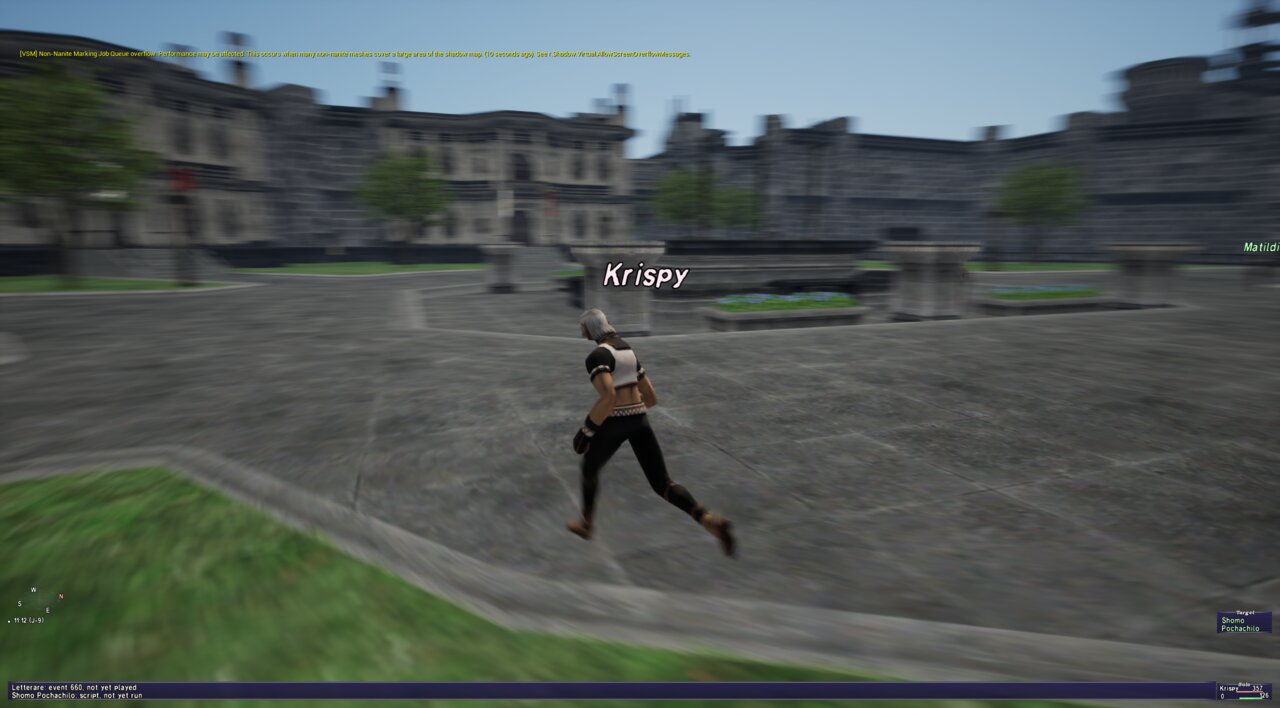
The image is a real, unedited regional playtest capture from 11 October. It shows the existing San d’Oria courtyard and character as context for the adventure these systems support. It predates this checkpoint, includes an unresolved shadow warning and does not demonstrate the new crafting, magic-burst or Trust features.
What comes next
I am continuing the narrow companion gameplay checks, quest and NPC edge cases, and the remaining crafting, equipment and interface work. Each coherent change needs its own source-bound checks and appropriate package coverage before broader admission.
The aim remains the same: preserve the recognizable character of FFXI while building an adventure whose movement, interactions, combat and saved progress work together. There is still no public download or testing signup.